
Long-Term Investing in Indian Stocks: A Simple Checklist to Pick Quality Companies
Seven questions to ask about any company before you invest for years, how to think about valuation, SIP or lump sum, how to build and rebalance a portfolio, and the capital gains tax basics.
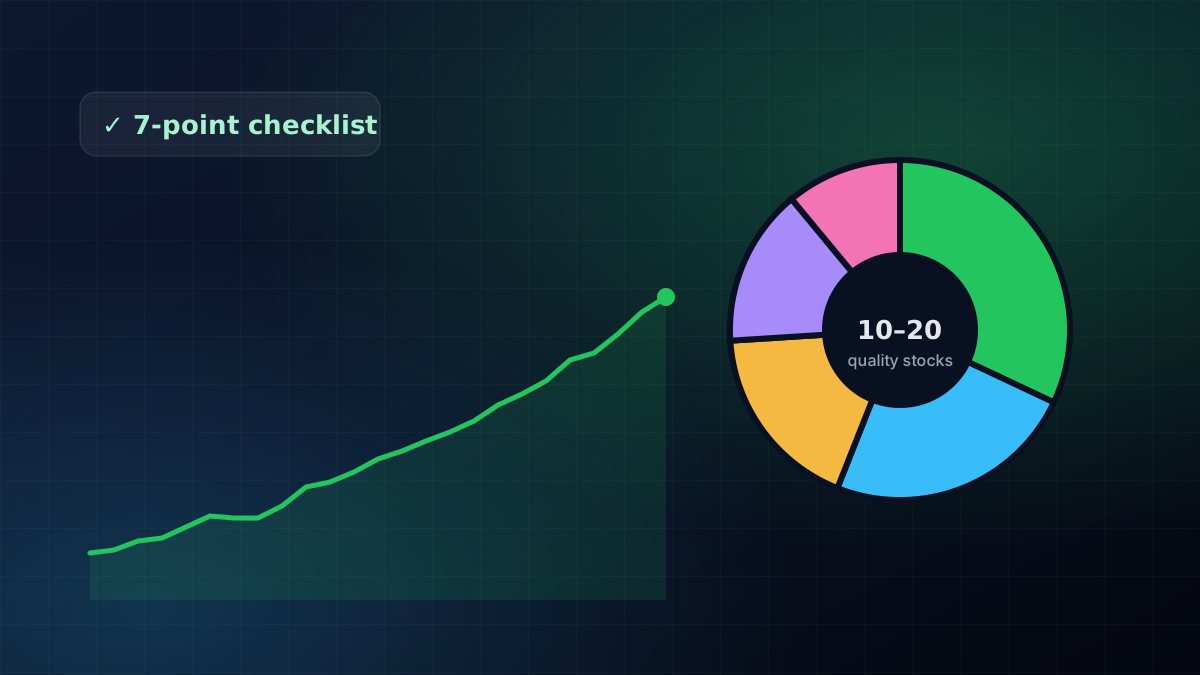
Trading is about the next few hours or days. Investing is about the next five to fifteen years. The skills are different, and so is the risk: an investor's biggest danger is not a single bad day, it is owning a weak business for a long time, or selling a good one in a panic. This guide gives you a simple, repeatable checklist.
Before you buy a single share#
- Emergency fund first: keep six months of expenses in a safe place, so you never have to sell shares in a crash to pay a bill.
- Clear high-interest debt: paying off a 36% credit card balance is a guaranteed return no stock can promise.
- Know your time horizon: money you need within three years generally does not belong in individual stocks.
The seven-question quality checklist#
For any company you consider, look at at least five years of data. Annual reports and stock-screening websites make this free and fast.
- Is revenue growing steadily? A business that sells more each year, without wild swings, is easier to own through bad markets.
- Is it profitable, and does the profit turn into cash? Compare net profit with operating cash flow. Profits that never arrive as cash are a warning.
- How much debt does it carry? For non-financial companies, a debt-to-equity ratio below 1 is a comfortable rough guide. High debt hurts most when rates rise or sales fall.
- Does it earn a good return on the money it uses? Return on equity (ROE) and return on capital employed (ROCE) consistently above about 15% often point to a strong business.
- What are the promoters doing? Look at promoter holding over time and, importantly, pledged shares. Rising pledges can force sales at the worst moment.
- Is there a durable advantage? A trusted brand, a cost advantage, a network or switching costs that keep customers coming back.
- Is the price reasonable? Compare the price-to-earnings (P/E) ratio with the company's own history and with its peers. A great company bought at any price can still be a poor investment.
Valuation in plain words#
A share price is what you pay; the business is what you get. If a company earns ₹100 crore a year and the whole company is valued at ₹4,000 crore, its P/E is 40. You are paying 40 years of today's profit. That can make sense if profits will grow fast for many years, and it is dangerous if growth slows. Patient investors often add to good companies when the whole market is falling, not when everyone is excited.
SIP or lump sum?#
- SIP (systematic investment plan): a fixed amount every month. You buy more shares when prices are low and fewer when they are high, and you remove the stress of timing.
- Lump sum: investing a large amount at once. It can work well over long periods, but a fall right after you invest can be hard to sit through.
- Many investors combine both: a monthly SIP for regular savings, and extra lump sums into existing holdings during broad market corrections.
Building and rebalancing a portfolio#
For most people, 10 to 20 quality stocks across different sectors, or a low-cost index fund at the core with a few stocks around it, is enough. Owning 60 stocks is usually just an index fund with more work.
Rebalance once a year. If one sector has grown to dominate your portfolio, trim it back to your planned weight and add to the parts that fell behind. This forces you to sell some of what got expensive and buy what got cheaper, which is hard to do by feeling.
Tax basics for Indian investors#
Since the Union Budget of July 2024, for listed equity shares and equity mutual funds:
- Short-term capital gains (held 12 months or less): taxed at 20%.
- Long-term capital gains (held more than 12 months): taxed at 12.5% on gains above ₹1.25 lakh in a financial year.
- Dividends are added to your income and taxed at your slab rate.
Tax rules change, so check the current rules or ask a chartered accountant before you sell, especially for large amounts.
A one-page investing routine#
- Monthly: run your SIP and glance at results announcements for your companies.
- Quarterly: read the results and the management commentary. Has anything in your "why I bought" note changed?
- Yearly: rebalance, r each holding against the seven questions, and sell only if the business has changed, not just the price.
Where Profit Hunter Guru fits in#
Our Investing Course turns this checklist into a full process: how to read the numbers, sector rotation and market cycles, building and rebalancing a portfolio, SIP versus lump sum, and tax basics. The Indian Market Bundle adds the Intraday course, Price Action and the BEST Indicators & EA, for those who also want to trade.
🧮 Size your next trade with the free position size, risk-reward and lot size & margin calculators.
Comments
Loading comments…