
Risk Management with the 1% Rule: How to Size Every Trade (With a Calculator)
The 1% rule is the simplest risk rule that works: never lose more than 1% of your capital on one trade. How to use it for shares, Nifty options and XAUUSD gold, why it keeps you in the game during a losing streak, and a free calculator.
Most traders who blow up an account do not do it with one terrible idea. They do it with a few ordinary losing trades that were simply too big. The setup was fine, the stop-loss was reasonable, but the position was three or five times larger than the account could handle. A short losing streak, which happens to every trader, did the rest.
The 1% rule is the fix. It is not clever and it will not make a trade more likely to win. What it does is decide, before you enter, how much you are allowed to lose, and then work backwards to the size of the position. Get this one habit right and most other mistakes become survivable.
The rule in one sentence#
Never risk more than 1% of your trading capital on a single trade.
The 1% rule
"Risk" here means the amount you lose if your stop-loss is hit, not the amount you invest. You can buy a position worth 20% of your account and still risk only 1%, if the stop-loss is close enough. You can also buy a position worth 5% of your account and risk far more than 1%, if you have no stop at all.
Why 1%? The losing-streak test#
Every trading method has losing streaks. Even a method that wins half the time will, over a few hundred trades, almost certainly have a run of eight or ten losses in a row. The question is what that run does to your account.
| Risk per trade | After 5 losses in a row | After 10 losses in a row | Gain needed to get back |
|---|---|---|---|
| 1% | 95.1% of capital left | 90.4% left | About 11% |
| 2% | 90.4% left | 81.7% left | About 22% |
| 5% | 77.4% left | 59.9% left | About 67% |
| 10% | 59.0% left | 34.9% left | About 187% |
At 1% per trade, ten straight losses leave you with about ₹90,400 out of ₹1,00,000. That hurts, but you can keep trading and fix what went wrong. At 10% per trade, the same streak leaves you with about a third of your money, and you would need to nearly triple it just to break even. Most people who reach that point stop trading or start taking reckless trades to win it back.
How to size a trade in four steps#
- Find your risk amount. Capital × 1%. With ₹1,00,000, that is ₹1,000.
- Find your stop-loss on the chart. Put it where the trade idea is clearly wrong, for example below the low of the setup, not at a round number you picked to feel safe.
- Find the risk per share or unit. Entry price minus stop-loss price. Entry ₹500, stop ₹490 means ₹10 per share.
- Divide. Risk amount ÷ risk per share = position size. ₹1,000 ÷ ₹10 = 100 shares.
Notice that the stop-loss decides the size, not the other way round. A wide stop means a small position; a tight stop allows a bigger one. Never move the stop closer just to buy more. The position size calculator does these four steps for you, and warns you when even the smallest position breaks your limit.
Open the position size calculator →
Worked example 1: a stock trade#
Your capital is ₹1,50,000, so 1% is ₹1,500. You want to buy a stock at ₹1,240 with a stop at ₹1,215, which is ₹25 of risk per share. Position size: ₹1,500 ÷ ₹25 = 60 shares, worth about ₹74,400. If the stop is hit you lose ₹1,500 plus charges. If you hoped to buy 200 shares because the setup looked strong, the rule tells you that would risk ₹5,000, more than 3% of your account.
Worked example 2: a Nifty option#
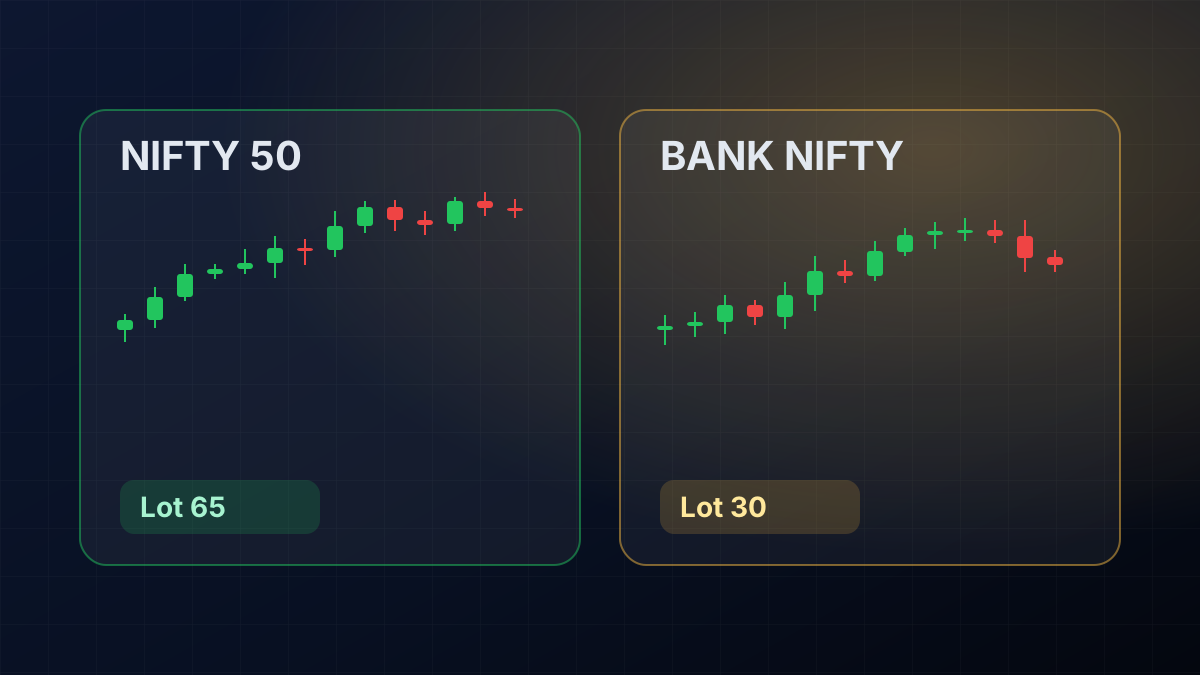
Options come in lots, so you size in whole lots. Your capital is ₹2,00,000 and your limit is ₹2,000. You plan to buy a Nifty option at ₹120 with a stop at ₹90: ₹30 of risk per unit. With a lot size of 65 (as of October 2026), one lot risks 30 × 65 = ₹1,950. One lot fits; two would risk ₹3,900.
Two things are different with options. First, the stop is on the option premium, not on the index, so decide it from the option's chart or from the index level where your idea is wrong. Second, options can jump past your stop on fast days, especially near expiry, so your real loss can be larger than planned. Many traders use a slightly smaller risk, say 0.5% to 0.75%, for options for this reason.
Worked example 3: XAUUSD gold#
For Forex and gold, size is in lots too. A standard XAUUSD lot is usually 100 ounces, so 0.01 lot is 1 ounce and a $1 move in gold is $1 for every 0.01 lot. Say your account is $1,000 and 1% is $10. Your stop is $5 away from your entry. Each 0.01 lot loses $5 if the stop is hit, so you can trade 0.02 lots ($10 at risk). Check your broker's contract size first, as some use different units. Our XAUUSD course also covers the legal points Indian residents must check before trading gold through any platform.
Add a daily loss limit#
The 1% rule protects you from one bad trade. A daily loss limit protects you from one bad day. Pick a number, such as 2% or 3% of capital, or three losing trades, and stop trading for the day when you reach it. Bad days usually get worse when you keep trading to win the money back.
- Write your daily limit on paper next to your screen.
- When you hit it, close the trading app, not just the chart.
- Write in your journal what happened, while you still remember.
Risk-reward: the other half of the plan#
Knowing what you can lose is half the plan. The other half is knowing what you hope to make. If you risk ₹1,000 to make ₹2,000, that is a risk-reward of 1:2. Before costs, you only need to win about one trade in three to break even at 1:2, and one in two at 1:1. The risk-reward calculator shows the break-even win rate for any trade.
Do not overdo it. A target five times your risk looks good on paper but is reached far less often. A realistic target, set at the next clear level on the chart, is more useful than a dream target that the market rarely visits.
Is 1% always the right number?#
No number is perfect, and 1% is a starting point rather than a law. Some careful traders use 0.5% while they are still learning, so that their first hundred trades cost them less. Some experienced traders with a long, honest journal go up to 2%. Very few professional traders risk more than that on a single idea, however sure they feel.
If you are new, start at 0.5% or 1% and stay there for at least three months. Change the number only when your journal, not your mood, says your method has an edge. Changing your risk after one great week or one terrible week is how most accounts get into trouble.
As your account grows or shrinks#
The 1% rule adjusts itself. Recalculate your risk amount from your current capital, for example every Monday. If ₹1,00,000 grows to ₹1,20,000, your risk per trade becomes ₹1,200. If it falls to ₹85,000, it becomes ₹850. Your positions shrink automatically during a drawdown, which is exactly when you want to be smaller, and grow slowly when things go well.
Keep your trading capital separate from your savings and your emergency fund. The 1% rule only protects the money in the trading account; it cannot protect money you keep moving in to cover losses.
Common mistakes with the 1% rule#
- Counting the investment, not the loss. Buying ₹1,000 worth of shares is not "1% risk" on a ₹1,00,000 account; the risk is what you lose at the stop.
- No stop-loss order. A stop that lives only in your head is moved or forgotten. Place the order right after you enter.
- Raising risk after a win. A good week is not a reason to risk 3%. Keep the rule steady and let the capital grow.
- Resetting the rule with fresh money. Adding money to your account after losses to "try again" is a sign the size was wrong, not the luck.
- Forgetting costs. Brokerage, taxes and slippage add to every loss and take from every gain, so the real risk is a little higher than the plan.
A one-page plan you can copy#
- My trading capital is ₹____ (money I can afford to lose).
- My risk per trade is 1% = ₹____.
- My daily loss limit is ____% or ____ losing trades.
- For every trade I write down: entry, stop-loss, target, size, and why.
- I place the stop-loss order immediately after entry.
- Every Sunday I r my journal and change one thing at most.
The 1% rule is taught in the risk module of our Intraday Trading Course and our XAUUSD Gold Course, with more worked examples and a journal template. The free calculators are open to everyone, with no sign-up.
🧮 Size your next trade with the free position size, risk-reward and lot size & margin calculators.
Comments
Loading comments…